
Space Exploration, Light Pollution and the Future
This blog post was submitted by Jon Wong, a dark sky advocate from Pomona.
October 4th, 1957, marked the beginning of conventional space exploration. During the Cold War, the Soviet Union successfully launched the first satellite into space. Sputnik 1 began the space race, and billions of dollars from both the US and the Soviets would be invested in space exploration. Since Sputnik, space exploration has expanded deeper into space and as an industry. However, the continued rise in light pollution has severely impacted space exploration, making it more expensive and challenging. First, let’s understand the broader historical context of space exploration.
Early Beginnings
The roots of space exploration can be traced back to ancient Mesopotamia. Mesopotamians feared that solar eclipses were ominous signs for society and their personal health. Early scientists began to record eclipses in hopes of predicting future ones. As a result, they discovered a pattern for eclipses known as the Saros Cycle. Using clay tablets and sticks, the Mesopotamians explored the cosmos, seeking a scientific pattern to explain signs of impending danger. Since the beginning of our ancestry, humanity has sought to understand the night sky. Through their desire to predict the next flood and protect themselves from a disease, they laid the foundation for curiosity-driven cosmic exploration.
Scientific Revolution
The Scientific Revolution shifted the understanding of the sky. Previously, the Earth was widely believed to be motionless and at the center of the universe. Discoveries made during this time period are essential to modern-day space exploration. From Newton’s Law of Gravitation to Kepler’s Laws of Planetary Motion, space exploration only became possible through the discoveries made by scientists during this time period. The launches of Sputnik, Voyager I, and the ISS relied on ideas built from the Scientific Revolution. Unbeknownst to scientists of the Scientific Revolution, future physicists, scientists, and astronomers would build on their revelations to venture more often and deeper into space.
Pre-Sputnik
In 1903, Tsiolkovsky published The Exploration of Cosmic Space by Means of Reaction Devices. Here, he used the principles derived from Newton and created an equation (Fig. 1) that would change space exploration forever. Additionally, he proposed multistage rockets, a process used today, and envisioned an established long-term space station in the future.
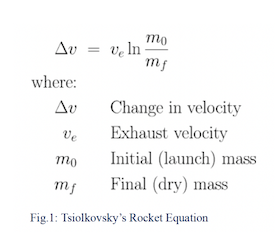
In the years to come, heavy investment in the industry, in light of World War II and the Cold War, led to unimaginable breakthroughs such as the V-2 Rocket and the R-7 Intercontinental Ballistic Missile.
Why Space Exploration Is Important
How can we ensure humanity can live on in the event of a catastrophic event? Nuclear warfare, resource shortages, diseases, or an asteroid impact. The scientific discoveries and technological advancements brought about by space exploration will become necessities for humanity's future.
Necessity is shaped by varying circumstances that influence a person’s perspective on what is deemed necessary. Although polarized, we can illustrate this with a 3-year-old child, who might consider gummies from the grocery store a necessity; meanwhile, a critically ill patient would probably prefer a new life-saving treatment. Some may argue that space exploration has little impact, if any, on the lives of the civilian population. With respect to the everyday citizen, space exploration may not necessarily be necessary. Providing for their children, having a roof over their heads, and ensuring clean water are concerns far more necessary than reaching interstellar space. In fact, it is the priority of many people to simply survive. 412 million children worldwide survive on less than three dollars a day, and 2.2 billion people lack clean water. The World Bank estimates an annual investment of 114 billion dollars per year to achieve universal safe access to water, sanitation, and hygiene. To put this number into perspective, space programs worldwide spend up to 137 billion dollars a year. If we simply put all of our money from space programs, billions of lives could be saved by ensuring access to safe water. Are the lives of 2.2 billion people more important than exploring the unknown?
This is a common misconception. Many argue that space exploration is an indulgence because the money could be spent elsewhere and would benefit more people. The budget of space programs is estimated to be around 137 billion dollars a year. Included in this budget are GPS, communication satellites, and weather satellites. These expenditures are extremely crucial and impact many people. GPS systems facilitate the flow of traffic, communication satellites are the foundation of the internet, and weather satellites allow travelers to choose their outfits for their two-week vacation. Space exploration isn’t just sending astronauts to space; it impacts our everyday lives.
How does space exploration affect the everyday lives of people worldwide? By engaging in space exploration, scientists and engineers encounter problems such as radiation, communication, and energy efficiency. This drives technological developments because these problems must be solved in order for space exploration to continue. The solutions to these problems can then be implemented into our everyday lives. For example, the invention of memory foam was initially used to provide a cushion for astronauts in space missions. Now, the same material is used in mattresses, couches, and seats around the world. Space exploration has a “spillover” effect because the advancements made by solving problems when traveling through space can affect people’s daily lives. Furthermore, the concept of necessity is dynamic. Electricity and the internet were once considered luxuries, but now they are essential parts of our everyday lives. The Wright Brothers could never have imagined the present-day aviation industry when they first tested their flights. Space exploration may seem optional in our circumstances now, but space exploration may be necessary in the future. Necessities are shaped by our circumstances, but we must prepare for when circumstances change. Asteroid impacts, nuclear war, climate change, and pandemics can change the course of humanity within months, even days. Continued investment and research into space exploration will prove vital in the wake of an inevitable world crisis. Limitless sources of clean energy, mining resources on celestial objects, or even becoming multi-planetary are all within the achievable scope. Most importantly, preserving humanity and ensuring our future generations are able to survive. Space exploration is now a necessity to skyrocket these possibilities in the future.
How Light Pollution Affects Space Exploration
As light pollutes our skies, it becomes increasingly challenging for scientists and researchers to observe planets, asteroids, and cosmic patterns. Due to this, many observatories such as Mount Wilson Observatory have been forced to either relocate their telescopes or shut down entirely. Mount Wilson, an historic observatory fifty minutes from downtown LA, has now turned into an education center due to its proximity to the light pollution. More and more observatories across the globe, stretching from Illinois to Vatican City, are now impractical and essentially unused for scientific purposes. These observatories are critical to space exploration and to understanding space itself. Observatories collect data on the movement of celestial objects, allowing scientists to study the universe across the electromagnetic spectrum and track near-Earth asteroids. In order to achieve the same objectives, researchers have needed to shift towards more remote sites to continue studying the cosmos, away from light-polluted areas. Researching space and venturing further into space will require significantly more resources, as the sky continues to be polluted. Ensuring space exploration can continue is imperative for humanity’s future. So, we must start with protecting our night sky.
Works Cited
Aerospace. “A Brief History of Space Exploration | the Aerospace Corporation.” Aerospace.org, 1 June 2018, aerospace.org/article/brief-history-space-exploration.
European Space Agency. “Konstantin Tsiolkovsky.” Esa.int, 2019, www.esa.int/Science_Exploration/Human_and_Robotic_Exploration/Exploration/Konstantin_Tsiolkovsky.
Garnier, Olivia. “Global Space Programs 2025: $137B Spending.” Novaspace, 10 Apr. 2026, nova.space/in-the-loop/national-space-programs-2025-investments-priorities-and-emerging-trends/.
Group, World Bank. “Child Poverty: Global, Regional and Select National Trends.” World Bank, World Bank Group, 9 Sept. 2025,
“In Pictures: Starvation in Gaza.” Cnn.com, CNN, 2025, edition.cnn.com/interactive/2025/07/world/photos-starvation-in-gaza-intl-cnnphotos/.
NASA. “Memory Foam - NASA.” NASA, 11 Feb. 2016, www.nasa.gov/image-article/memory-foam/.
---. “Orbits and Kepler’s Laws - NASA Science.” Science.nasa.gov, NASA, 26 June 2008, science.nasa.gov/resource/orbits-and-keplers-laws/.
Rabin, Sheila. “Nicolaus Copernicus.” Stanford.edu, Stanford Encyclopedia of Philosophy, 30 Nov. 2004, plato.stanford.edu/entries/copernicus/.
Schneider, Keith. “Universal Access to Clean Water and Sanitation within Reach.” World Economic Forum, 7 June 2021, www.weforum.org/stories/2021/06/achieve-universal-access-clean-water-sanitation/.
Sokol, Joshua. “How the Ancient Art of Eclipse Prediction Became an Exact Science.” Quanta Magazine, 5 Apr. 2024, www.quantamagazine.org/how-the-ancient-art-of-eclipse-prediction-became-an-exact-science-20240405/.
Green, Richard. “Light Pollution Is Encroaching on Observatories around the Globe – Making It Harder for Astronomers to Study the Cosmos.” Space, 10 Aug. 2025, www.space.com/astronomy/light-pollution-is-encroaching-on-observatories-around-the-globe-making-it-harder-for-astronomers-to-study-the-cosmos.